Our small team of friendly, passionate, dedicated staff play a vital role in delivering our services and ensuring the families we work with don’t face childhood cancer alone.
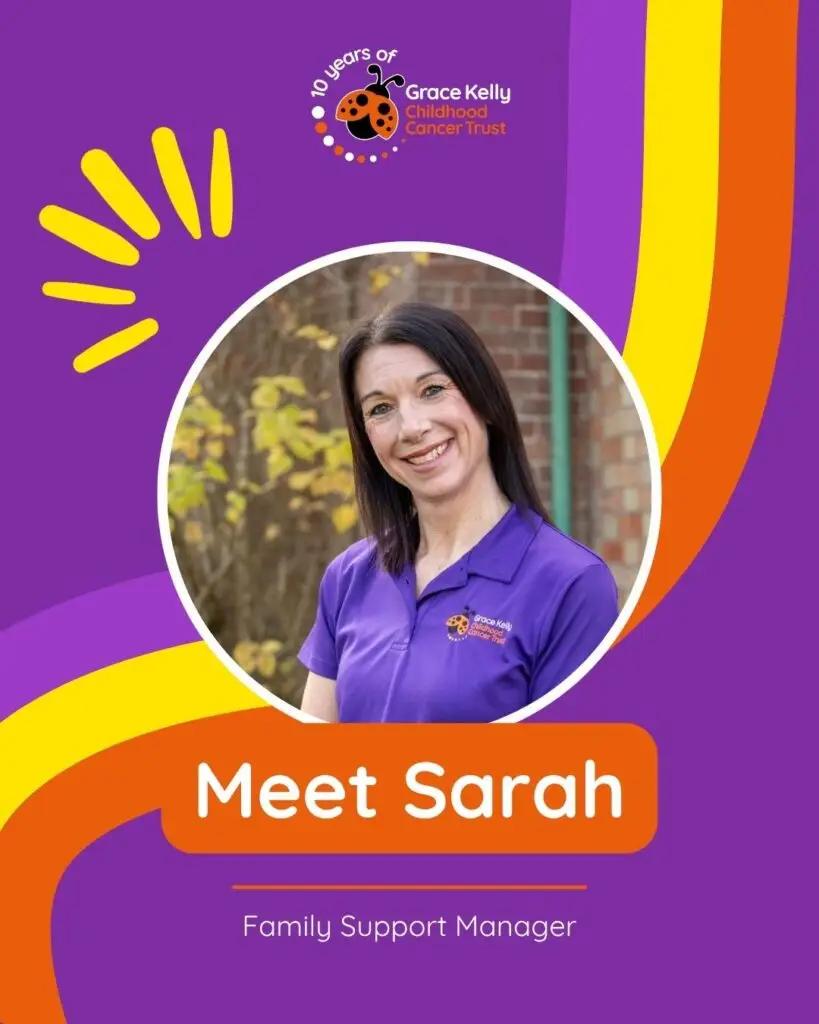
Here, in the first of a new series of articles, we catch up with our Family Support Manager, Sarah, to find out more about her role and how the Family Support Team support children and their families across Worcestershire, Gloucestershire and Herefordshire.
When did you join the Trust?
I joined the team in 2021, following almost 20 years working as Community Nursery Nurse in the NHS, as part of the Starting Well Public Health Nursing Team. Before that, I was a Nursery Nurse working mainly in private day nurseries, so I’ve always worked with children. It’s a real passion of mine.
What does your role entail?
I was brought in to set up the Trust’s Family Support Service. We’re a team of four who provide support and services to around 200 families across Worcestershire, Herefordshire and Gloucestershire. We do outreach work in homes, schools and hospitals, providing emotional support for parents and siblings of children who have – or are recovering from – cancer, along with activities and emotional support for the children. We try to give the children a safe space to express how they’re feeling, and open-up away from the family to explore and make sense of their feelings. It’s all about making a difference, doing what’s right for each family, and helping them cope with the journey they’re going through. We also offer bereavement support to families and will be there for them for as long as they want us to be.
What does a typical day look like for you?
No two days are the same. It’s one of the things I love about the role.
One day, I might be doing arts and crafts or playing games with a child to keep them occupied and stop them from feeling bored and frustrated. The next, I could be arranging school visits to work on our emotions programme with a sibling. We also offer advice to schools on how best to support the child when reintegrating back into school following treatment but also how to support their classmates. Once a diagnosis has been made, treatment often starts straight away, meaning their friend can often disappear for weeks on end. So, helping their classmates to understand what is happening is essential.
It’s all driven by what the children and their families need. Everyone’s different, and we get involved with them at different stages of their journey. The point is, we’re here for them whenever they need us.
How do you support the siblings of children with cancer?
Brothers, sisters, cousins and friends of children who have cancer often get overlooked. But it’s important to remember that it affects them too, especially if they are younger and struggle to understand what’s happening and how they should feel about it.
So, a big part of what we do is supporting siblings at home or in school to give them space to talk about things in simple, child-friendly terms. Our emotions programme is a low-level intervention-based programme that helps them to understand and process their thoughts and feelings around their brother or sister having cancer. This is usually completed in school over five to six weeks.
Again, everyone’s different, so it’s just about being there whenever they need us, to help everyone make sense of things.
What’s the most challenging aspect of your role?
Challenging is probably the wrong word. It can get emotional at times, because cancer is an extremely serious subject that affects everyone differently. But it’s a privilege to be let into the children’s homes and families and become part of their journey. That’s the really rewarding part of the job.
What difference do you see the Trust’s support making to the families you work with?
I think just being available, listening and providing sound advice, information and support whenever a family needs us gives them a huge amount of comfort.
We get involved at every stage of the journey; we never discharge families from our caseloads. Some families might not want us until their child has completed treatment and they are starting to rebuild their lives. It’s at this point that the impact of what they’ve been through starts to hit them, so we can be there to help them to process their thoughts and feelings. Others might want us there right from the start. Some might see us initially, drop off, then come back a few years later.
Everyone’s different but just knowing we’re there for them when they need us is what counts.
We still see families who’ve been with us for years, and it’s always great to check in and see how things are going.
What types of activities do you organise for the children and families?
It varies, really. It’s all about trying to keep things as normal as possible for the children we work with and supporting them through the different stages of their journey, whether that’s during treatment, recovery, relapse or palliative care.
A lot of it is providing emotional support and just being there to listen and help them understand and process what they’re going through, answer any questions and provide them with the right information. We’ll often just play games, do arts and crafts or other activities with the children to help them take their mind off things
We’ve also got our AV1 Robots, which are brilliant for keeping children connected to their classrooms and friends when they are too poorly to attend school. A robot sits on the child’s desk and lets them join in with lessons from home or hospital, via an app on their phone or tablet. They can see and hear everything that’s happening, put their hand up to ask questions, and even chat with their friends at breaktime. It’s wonderful to see how excited the children get when they realise they don’t have to miss out on school life. The robots prevent the children from feeling isolated, help them maintain their precious friendships and keep them feeling part of their class during treatment. They also help to promote a smooth integration back into school once the child feels well enough.

Finally, what’s the most rewarding part of your job?
Like I said earlier, it’s a privilege to be a part of the children’s journeys and make a positive difference to their lives. Although cancer is a serious matter, it isn’t all doom and gloom. At the end of the day, they are just children, and it’s all about making them smile and helping them to forget what they are going through, even if it’s just for a little while.
If we can do that for everyone we work with, it’s a job well done.
How we can help you
When your child has been diagnosed with cancer, it can be overwhelming and emotional.
Sarah and our Family Support Team are here to help.
To find out more about our work and the support we can provide, don’t hesitate to reach out and ask for help.
You don’t have to go through this alone.
