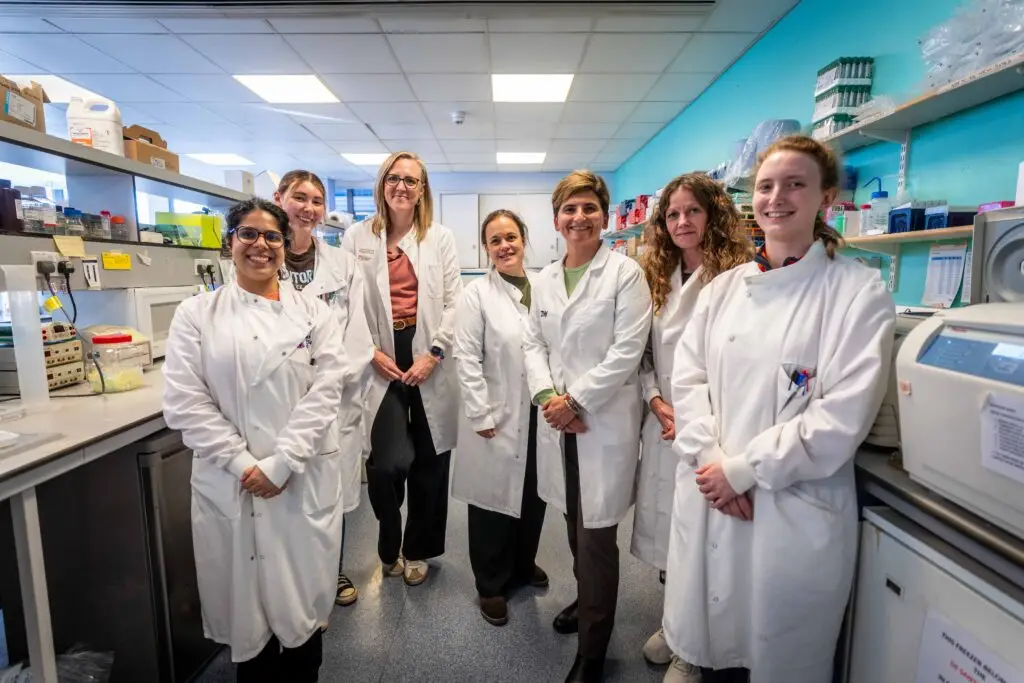
Members of the Grace Kelly Childhood Cancer Trust Team had the pleasure of visiting Birmingham Children’s Hospital and the University of Birmingham in October, providing an opportunity to meet the researchers behind projects that have been supported by the Trust, to see the progress being made and an opportunity to reflect on why continued investment in childhood cancer research is so important to our mission.
Dr Jennifer Kelly reflects on the day.
We were incredibly proud to spend the day with research teams at Birmingham Children’s Hospital and the University of Birmingham, meeting some of the dedicated people working to improve outcomes for children with cancer.
The visit offered an encouraging insight into the research taking place and the potential it holds for children and families, from exploring how artificial intelligence could help doctors diagnose brain tumours more quickly to hearing about advances in immunotherapy for childhood sarcomas.
Exploring how AI could support brain tumour diagnosis
Our day began at Birmingham Children’s Hospital, where we met Dr John Apps and his team to learn more about their project, “Advancing Non-Invasive Brain Tumour Diagnosis through AI-driven Clinical Decision Support.”
Funded by the Grace Kelly Childhood Cancer Trust in partnership with The Brain Tumour Charity, the project, in simple terms, is exploring how artificial intelligence can help doctors interpret information from scans to identify brain tumours more quickly and accurately.
The aim is to support clinical decision-making and help children and their families get answers sooner.
It was fascinating to hear about the work underway and how advances in technology could help improve the diagnostic process for children with suspected brain tumours.

Seeing the impact of innovation in the operating theatre
During our visit, we also had the opportunity to see the hospital’s new intraoperative MRI scanner and hear how it is already making a real difference to children having brain tumour surgery.
Previously, surgeons have relied on scans taken before an operation to understand the tumour’s location and plan its removal. However, the brain can shift during surgery, meaning the original images may no longer provide a completely accurate picture.
The new intraoperative MRI scanner allows the surgical team to take new images while the child is still in theatre. This helps them check in real time whether the tumour has been successfully removed without having to wake the child up.
For families, that can mean greater certainty much sooner and potentially avoiding another operation or anaesthetic.
Seeing this technology first-hand was a powerful reminder of what investment in research, innovation and specialist equipment can make possible. Behind every advance is the opportunity to improve a child’s treatment experience and ultimately, their outcome.
Meeting the next generation of childhood cancer researchers
We then visited the University of Birmingham, where we spent time with Professor Amos Burke, Professor of Paediatric Oncology and Director of the Cancer Research UK Clinical Trials Unit, alongside a number of early-career researchers and PhD students.
One of the highlights for our team was meeting these researchers and hearing about the work they are doing. Their passion and commitment to improving outcomes for children and young people with cancer really shone through.
It was encouraging to see so many people working to better understand childhood cancer and find more effective treatments. With so much still to learn, supporting the next generation of researchers is an important part of moving this work forward. Their ideas, dedication and research today could help shape the treatments available to children in the future.
For some childhood cancers, particularly rare and complex types, there is still much to learn. Encouraging talented researchers to work in this field and giving them opportunities to develop their research is an important part of addressing these challenges.

Understanding the immune system’s role in childhood sarcoma
We were also delighted to meet Dr Carmela De Santo and hear about her completed research project, “Understanding the ability to activate key immune cells which have the function of inhibiting MDSCs and allowing the immune system to target and kill childhood sarcoma.”
It is a complicated piece of science, but essentially Carmela has been looking at how we can help the immune system recognise and attack childhood sarcomas more effectively.
Hearing about the progress made through this work, and seeing Carmela’s passion for the research, was incredibly encouraging. Research like this helps build understanding of how childhood cancers behave and explores potential approaches that could contribute to future treatments.
Why continued investment in childhood cancer research matter?
One of the biggest things we took away from the day was a real sense that progress is being made. There is exciting science underway, greater collaboration and a community of dedicated researchers working to improve things for children and families.
But there is also no doubt that there is still so much more to do.
Childhood cancers are not simply smaller versions of adult cancers. Many are rare, and some require highly specialised research to understand their biology and develop more effective treatments. Children can also experience long-term effects from their treatment, making the search for kinder, more targeted approaches particularly important.
Continued investment helps researchers investigate new ideas, build evidence, develop potential treatments and move promising findings towards clinical practice. Progress takes time, collaboration and sustained funding.
For the Grace Kelly Childhood Cancer Trust, supporting research is an essential part of our commitment to children and families affected by childhood cancer. We want to help fund work that improves understanding, advances treatment and gives children the best possible chance of a brighter future.
We are incredibly grateful to Dr John Apps, Professor Amos Burke, Dr Carmela De Santo and their teams who took the time to share their work with us.
It was a privilege to see the research we are helping to fund, meet the people behind it and hear how their work could contribute to improvements in diagnosis and treatment.
Visits like this bring home why research funding matters. Every project represents people asking important questions, testing new ideas and working towards better outcomes for children with cancer, both now and for the children who will be diagnosed in the future.
Because the children of today all deserve a tomorrow. 💛
